For many underwater pilots, a home-built ROV sounds like the perfect project. And often there is a hope of saving money that way. So that you do not start with false expectations, here is our honest assessment up front: building your own pays off for tinkerers and learners, not for saving money.
Transparency: We have not built an ROV ourselves and have not had any of these devices in our hands. Everything here is based on manufacturer information, shop pages and posts in the Blue Robotics forum. Prices: without guarantee, as of October 2026. The original prices are in US dollars; euro values are “converted approx.” at US$1 ≈ €0.90. Customs duty, import VAT (AT 20%, DE 19%) and Swiss VAT respectively are not included. According to Blue Robotics, local dealers usually include customs and taxes in their prices already.
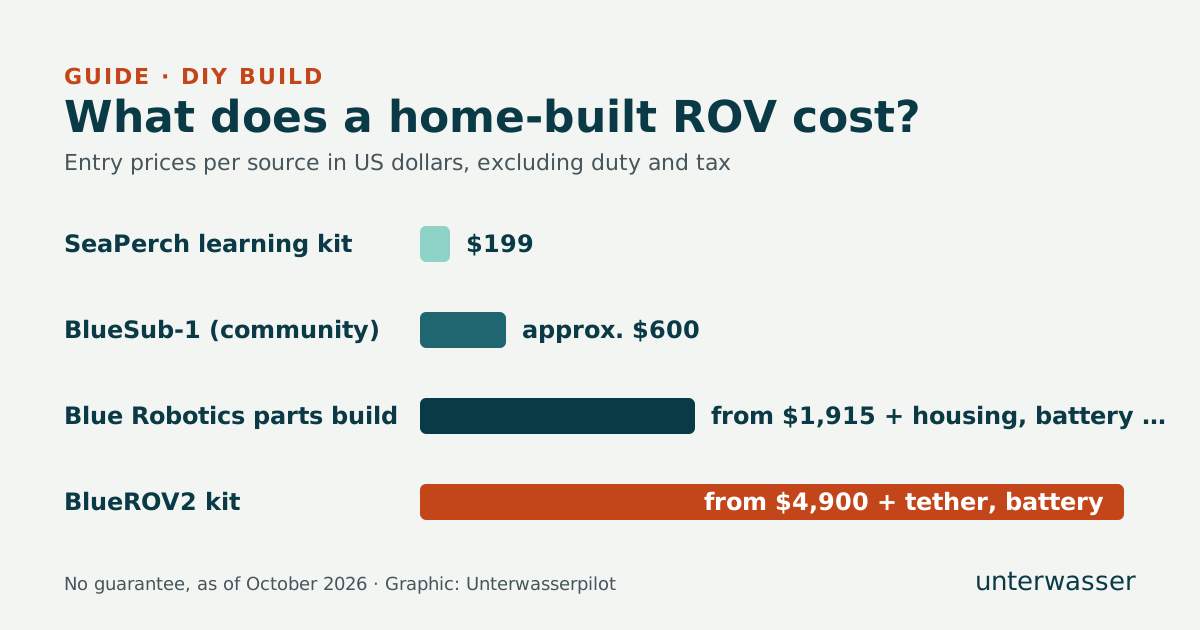
- Saving money: Building your own pays off for learning and tinkering, not for saving.
- Reference: The BlueROV2 costs from US$4,900 according to the manufacturer, without tether, battery, charger and gamepad.
- Under €1,000: There are only learning kits without a camera, such as SeaPerch for US$199.
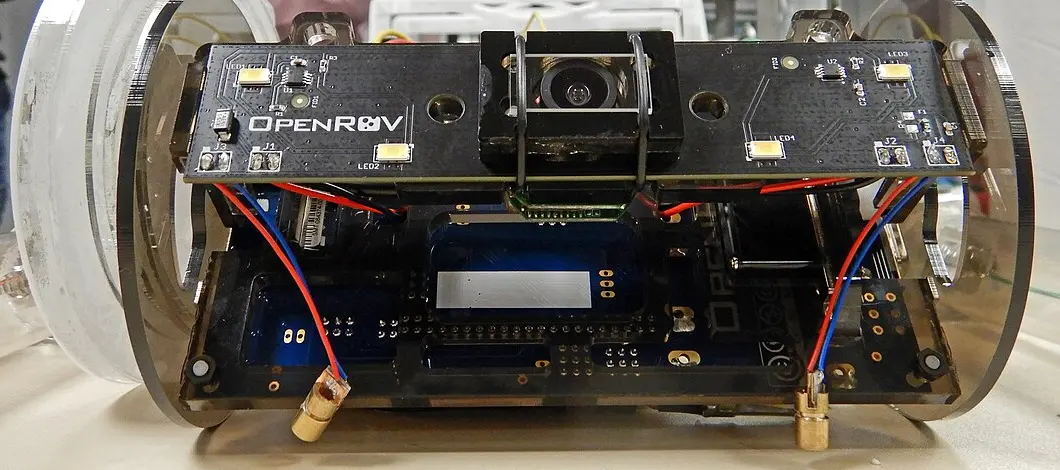
- OpenROV: The project is no longer available.
Briefly explained: the key terms
- ROV (Remotely Operated Vehicle): a remote-controlled underwater vehicle connected to the surface by a cable. In the hobby field we mostly say underwater drone. More in What is an underwater drone?
- Thruster: the propulsion units, i.e. waterproof motors with propellers.
- ESC: the motor controller that drives each thruster.
- Tether: the connecting cable between the drone and the surface.
- ArduSub: free control software for ROVs, the brain of the drone, so to speak.
- BlueOS and Cockpit: the operating system on the drone and the ground station software on the laptop respectively, both from Blue Robotics.
The reference: BlueROV2 – more kit than home build
If you look into home-built ROVs, you quickly end up at the BlueROV2 from Blue Robotics. It is something of a standard in the scene: open, well documented and with a very active English-language community.
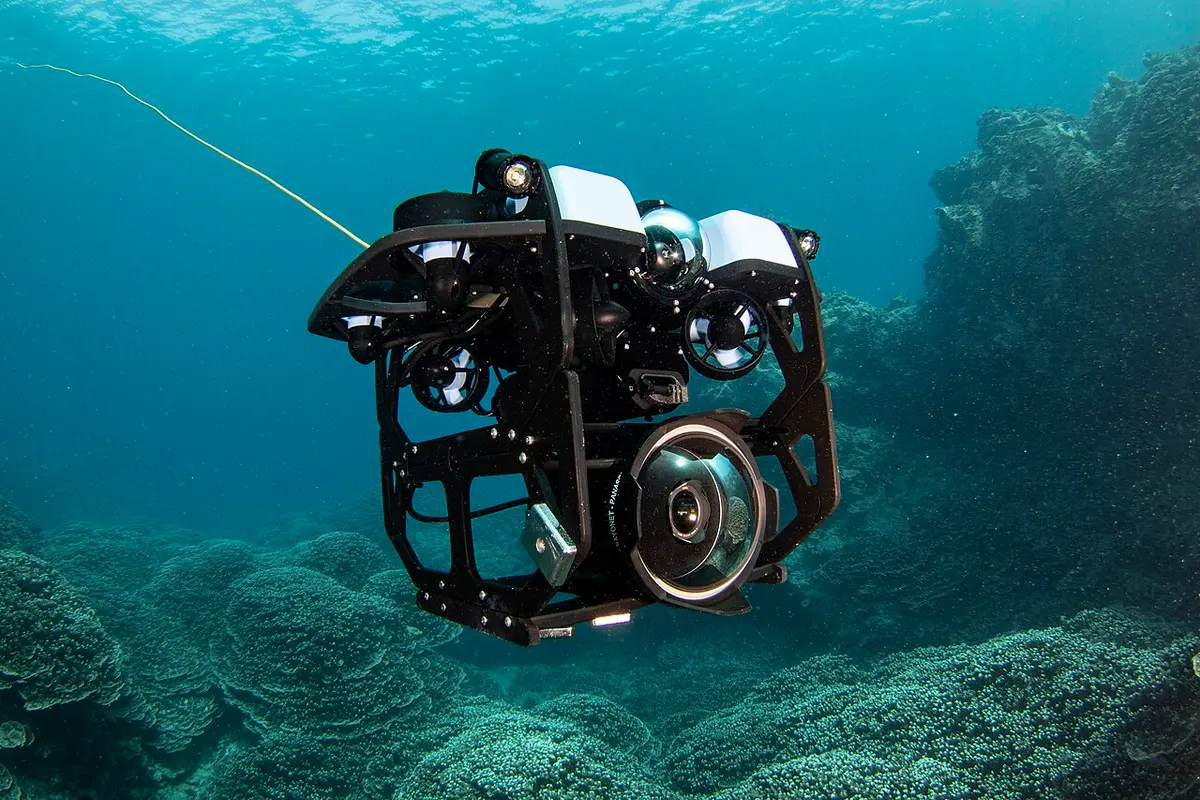
According to the manufacturer, the BlueROV2 costs from US$4,900 (converted approx. €4,400). It comes partly assembled, and assembly is said to take 6 to 8 hours. So it is more “screwing a kit together” than a real home build.
According to the product page, the basic package includes, among other things, the frame, electronics and battery enclosures, six T200 thrusters, a depth sensor, a camera with a tilt mechanism, tools including a vacuum pump, and the Fathom-X Tether Interface (FXTI) surface box. According to the manufacturer, the camera delivers 1080p at 30 fps and works down to 0.01 lux. Depending on the enclosure (acrylic or aluminium), Blue Robotics gives a dive depth of 100 m or 300 m respectively.
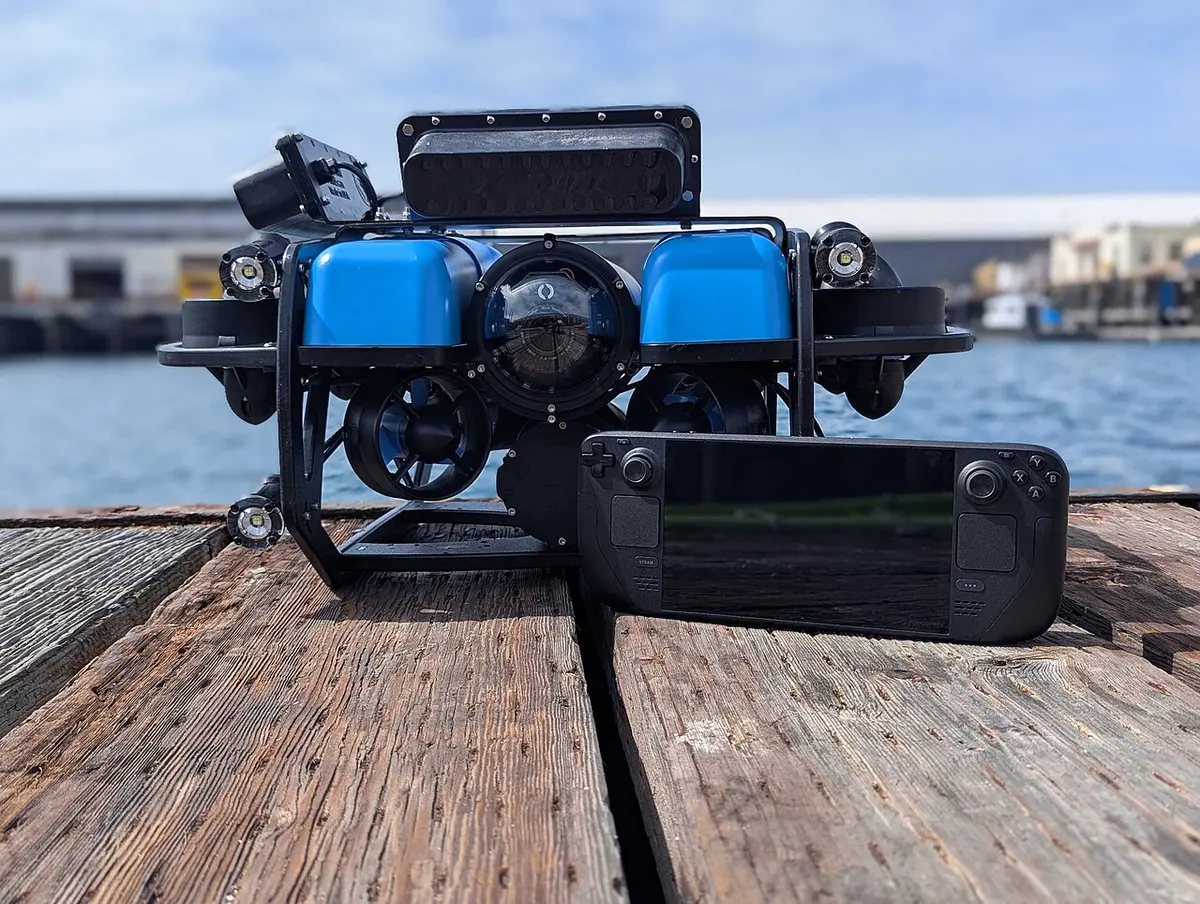
Not included, according to the manufacturer:
- the tether, e.g. 25 m for US$250 (converted approx. €225) up to 100 m for US$490 (converted approx. €440)
- the battery (14.8 V lithium-ion; according to the manufacturer, it cannot be shipped to all countries)
- the charger
- a gamepad
- a laptop
With 100 m of tether, a battery and a charger, you end up, by our estimate, at over US$5,500. We have not researched the prices for the battery and charger individually, so this is a rough guide. Older articles still quote around US$3,000. These figures are out of date; the price has risen considerably.
Good news for buyers in the DACH region: Blue Robotics lists a German dealer, Underwater International GmbH in Bremen. For Austria and Switzerland, no dealer of their own is listed.
Why rebuilding from individual parts hardly saves money
The obvious idea: instead of buying the kit, you just get the individual parts and build the enclosure and frame yourself. Let us work it out with Blue Robotics’ prices, for an absolute minimum version with only four thrusters:
| Component | Price according to the manufacturer |
|---|---|
| 4 × T200 thruster (from US$230 each) + 4 × Basic ESC (US$40 each) | US$1,080 |
| Navigator flight controller board | from US$220 |
| Low-light HD USB camera | US$120 |
| 25 m tether | US$250 |
| FXTI surface box | US$245 |
| Total | approx. US$1,915 (converted approx. €1,720) |
And that still leaves out the enclosure, cable penetrators, frame, battery, charger, Raspberry Pi, depth sensor, gamepad, plus customs and tax.
An experience from the Blue Robotics forum fits this: a Blue Robotics intern, rebuilding the BlueROV2 from individual parts, ended up at around 50% more than the kit price, for materials alone and without working time. So the kit is not the expensive option but rather the cheap one.
Under €2,000: hybrid builds for advanced users
If a pure Blue Robotics parts build already comes close to the limit without the enclosure, all that remains is a mix of brand-name parts and cheap third-party components.
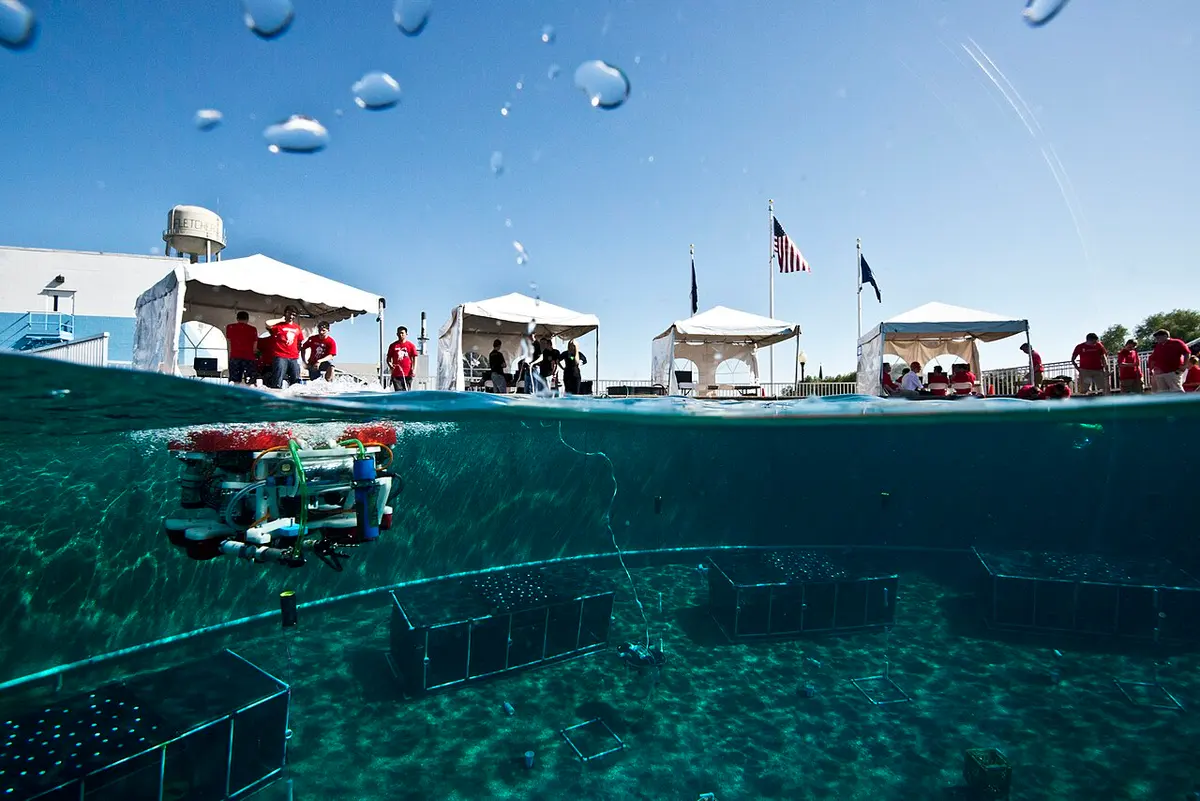
An exciting example is the “Mini BlueROV2” concept from the Blue Robotics forum (April 2026). According to his post, the creator plans eight small M060 thrusters (approx. US$30 each), two 4-in-1 controllers (approx. US$50 each), a flight controller (approx. US$80), a normal Ethernet cable instead of the expensive Fathom tether, ArduSub and BlueOS, and a 3D-printed frame. The goal is 100 m depth.
The catch: the project is still in the design phase; there are CAD designs, but no finished build plan and no total cost. According to our research, in this price range there is no finished, available kit with a camera and ArduSub.
For a project like this you also need quite a bit of skill: 3D printing, soldering, waterproofing, battery building and setting up ArduSub. For complete beginners, it only works with a lot of willingness to learn and patience.
Under €1,000: learning kits and hardware-store projects
Under €1,000 you only find learning and tinkering projects, but no real camera drone. The Blue Robotics forum also says that an ROV under US$1,000 is very difficult because thrusters and tethers are expensive. If you want to film on this budget, you are better served by a ready-made drone – more on this in the guide Underwater drones under 1,000 euros.
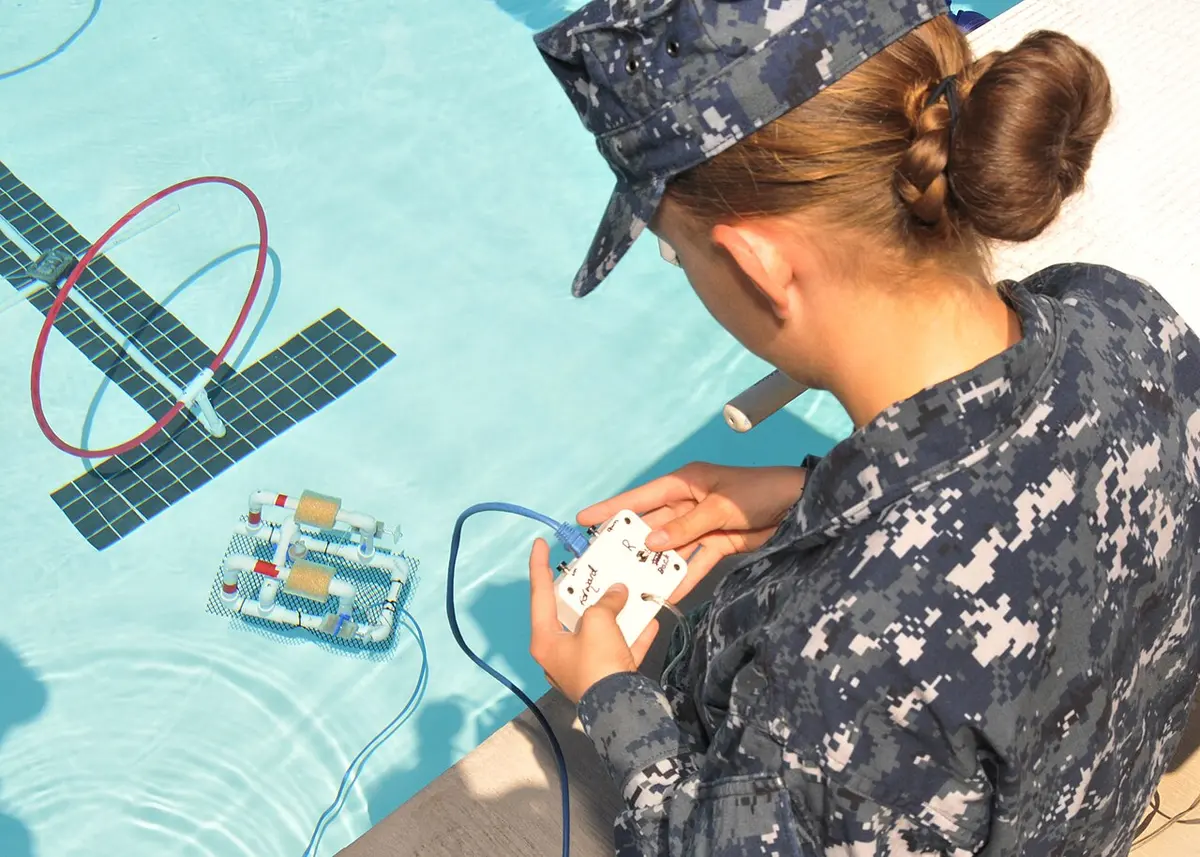
SeaPerch ROV Kit: The kit from RoboNation (developed with MIT Sea Grant) costs US$199 (converted approx. €180) according to the shop. It is meant for schools and education: PVC frame, 12 V motors, switch box, Cat-5 cable. According to the product description, a camera is not included, and we did not find information on depth, tether length and shipping to Europe in the shop. According to the Arduino blog, a version with Arduino modules, SeaPerch II, is in development (as of 2025).
BlueSub-1: A community project from the Blue Robotics forum (2022) with parts from the US hardware store. According to its creator, it cost around US$600 (converted approx. €540). Converted bilge pumps serve as motors, the housing is made of PVC pipe, and it is controlled with Arduino and rotary controls, without ArduSub. The aim was a depth of about 15 m in fresh water. A camera is not described, and there is no build guide ready to follow.
A camera can be retrofitted (Blue Robotics’ low-light USB camera costs US$120). But the real effort lies in the waterproofing and in transmitting the video to the surface.
A quick look back: what happened to OpenROV?
If you read older build reports, you often come across OpenROV. The open-source project was one of the pioneers, and the v2.5 kit cost US$850 at the time, according to a press report. Today OpenROV is no longer available: the last version, 2.8, dates from 2017, in 2019 the project was absorbed into Sofar Ocean, and the forums are archived. The electronics files are still on GitHub, so the project remains useful as inspiration.
All projects at a glance
| Project | Type | Price according to the source | Converted approx. | Camera | Control | Skill | Our assessment |
|---|---|---|---|---|---|---|---|
| SeaPerch ROV Kit | Learning kit | US$199 | €180 | no | Switch box | low to medium | good for learning, not a camera drone |
| BlueSub-1 | Community build (2022) | approx. US$600 in total | €540 | not specified | Arduino, no ArduSub | medium | tinkering project without a finished guide |
| “Mini BlueROV2” | Community concept (2026) | no total cost | – | planned | ArduSub + BlueOS | high | exciting, but still in the design phase |
| Parts build from Blue Robotics components | Home build | from approx. US$1,915 (without housing, battery etc.) | €1,720 + the rest | yes | ArduSub + BlueOS | high | hardly saves anything compared with the kit |
| BlueROV2 | Kit, partly assembled | from US$4,900 (without tether, battery, charger, gamepad) | €4,400 | yes, 1080p | ArduSub + BlueOS + Cockpit | medium (6–8 h assembly) | the reference, well documented, but expensive |
| OpenROV 2.x | Open-source kit | US$850 at the time | – | yes | own software | high | no longer available |
All prices without guarantee, as of October 2026. Euro values converted approx. at US$1 ≈ €0.90, without customs and tax.
Hidden costs to keep in mind
- Tether: Not included with the BlueROV2 and, depending on length, a real cost factor.
- Battery and shipping: According to Blue Robotics, batteries may not be shipped to all countries. Plan on a battery from a local source. How to keep it fit for a long time is in the guide Battery care.
- Charger, gamepad, laptop: missing from the basic package.
- Customs and tax: When ordering from the USA, import VAT of 20% is added in Austria and 19% in Germany, in Switzerland the VAT, and depending on the goods customs duty on top.
- Tools and time: Soldering station, possibly a 3D printer and many evenings.
A word on safety: lithium batteries, electricity and water only go together with clean work. We will look at the rules for drones in lakes and rivers in AT, DE and CH in a separate article.
What is worth it for whom?
- Do you want to understand how an ROV works, or are you looking for a project with children or the school? A learning kit like SeaPerch is a good start. But do not expect any film footage.
- Do you like tinkering, can you solder and do you have a 3D printer? Then a hybrid build like the “Mini BlueROV2” is exciting. Plan plenty of time and an open budget; there is no finished build plan yet.
- Do you want an open, expandable drone for serious projects? Then the BlueROV2 is the reference. Expect over US$5,000 including accessories.
- Do you just want to dive and film? Then a ready-made underwater drone is almost always the better and cheaper choice. You will find an overview in our ranking of underwater drones.
Conclusion
Building your own is a great hobby for anyone who likes to tinker, learn and understand their drone down to the last screw. It is not suited to saving money: under €1,000 there are only learning projects without a real camera, under €2,000 there is no finished kit with a camera and ArduSub, and rebuilding from individual parts ends up costing more than the BlueROV2 kit.
It is also striking that there are hardly any German-language build reports. The active scene meets almost only in the English-language Blue Robotics forum.
Show your build report in the Unterwasserpilot forum (German)! Whether it is a PVC pipe project, a SeaPerch with a camera upgrade or a BlueROV2 assembly: we look forward to your photos, questions and experiences.
Frequently asked questions
Is it worth building an underwater drone yourself?
Financially, usually not. A minimum version with four thrusters from Blue Robotics parts comes to around US$1,915, and that still leaves out the enclosure, frame, battery, charger and other parts. In the Blue Robotics forum, an intern reports that rebuilding the BlueROV2 from individual parts cost around 50 percent more than the kit. Building your own is worth it for learning and tinkering.
What does the BlueROV2 cost?
According to the manufacturer, from US$4,900 (converted approx. €4,400). Tether, battery, charger, gamepad and laptop are not included. The tether costs US$250 to US$490 depending on length. With 100 metres of tether, a battery and a charger, the total price is, by our estimate, over US$5,500.
Is there a home-built ROV under €1,000?
Only learning and tinkering projects, no real camera drone. The SeaPerch kit costs US$199 according to the shop and has no camera. The community project BlueSub-1 cost around US$600 according to its creator, and there is no build guide ready to follow. If you want to film, you are better served by a ready-made drone.
What skills do I need for building my own?
For demanding projects you need 3D printing, soldering, waterproofing, battery building and setting up the control software ArduSub. A learning kit like SeaPerch is much simpler.
Does OpenROV still exist?
No. The last version, 2.8, dates from 2017, in 2019 the project was absorbed into Sofar Ocean and the forums are archived. The electronics files are still on GitHub.
You can find reactions and comments on this article in the Unterwasserpilot forum (in German, English posts welcome).