Treasure hunting underwater sounds like an adventure. And CHASING now offers its own solutions for exactly that. We put in context what is available, what you can realistically expect and – very importantly – where you are allowed to search at all.
- Dory Explore: a small drone with a built-in metal detector and a net, depth up to 15 m.
- Range: According to reports, the detector only responds at a few centimetres – good for things lost at the jetty, not for large areas.
- Law: Deliberately searching for archaeological finds is prohibited in Austria without a permit, and in Germany and Switzerland requires a permit depending on the state or canton.
What CHASING offers: the Dory Explore
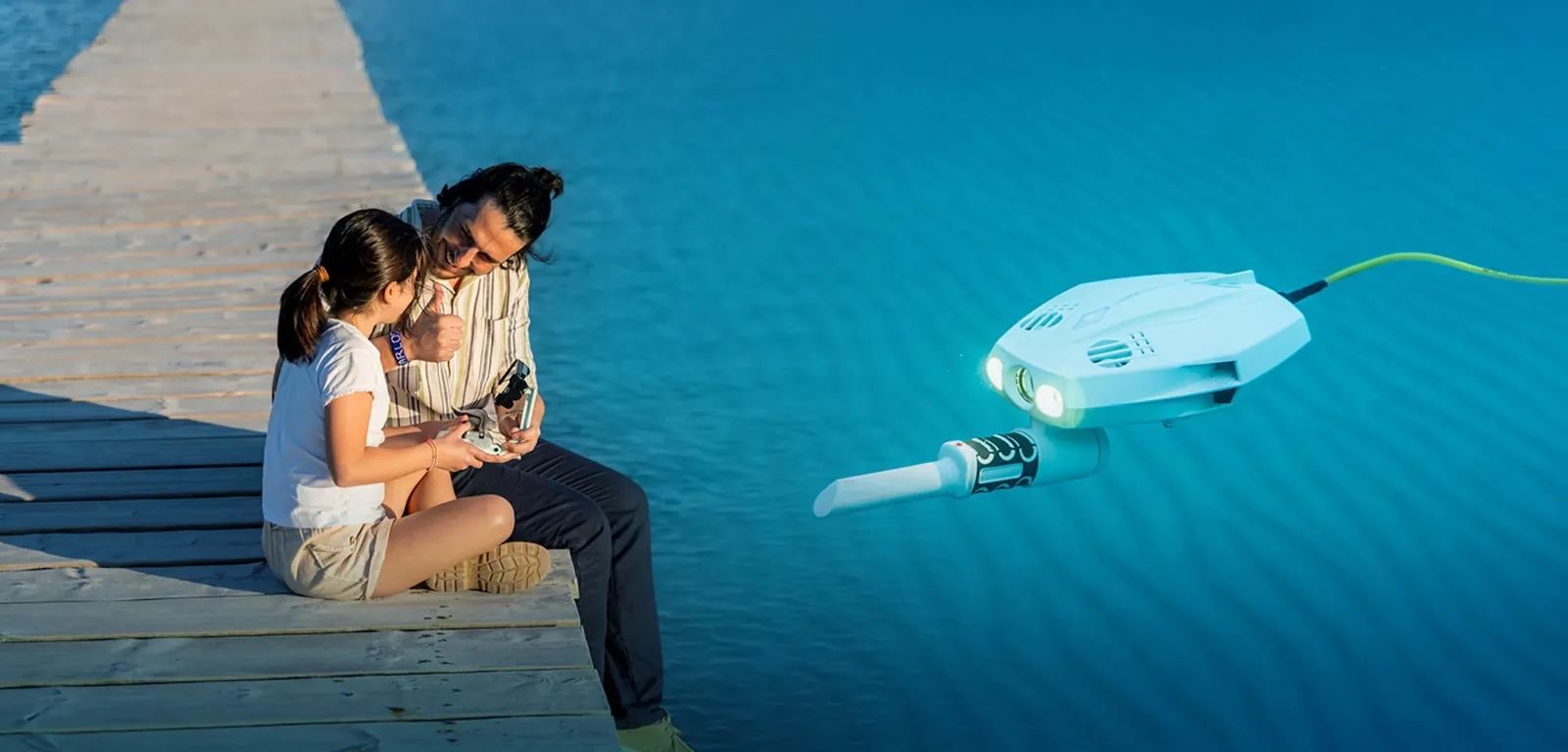
The best-known solution is the Dory Explore, a treasure-hunting version of the small Chasing Dory. It was presented around the turn of the year 2024/2025 (reports of 31 December 2024 and 2 January 2025). According to the manufacturer and trade reports, it comes with:
- a built-in metal detector,
- a detachable net, according to the manufacturer about 8 cm in size, for collecting small finds,
- Full HD video (1080p/30 fps) and 16 GB of internal storage,
- a maximum dive depth of 15 metres at a weight of around 1.1 kg,
- control via a smartphone app or a Bluetooth remote control.
When the detector responds, a red LED flashes, according to a report by Interesting Engineering, which you see in the camera image. The launch price was US$599, with an offer of US$479 at launch (without guarantee, as of December 2024 / January 2025). We could not reliably establish a current euro price or availability for Austria, Germany and Switzerland as of October 2026. For that, it is best to look directly at CHASING’s German-language site.
For context: in our ranking, the standard Dory is in 5th place (grade 4.1). It is an entry-level device, not a professional tool. That applies to the Explore too.
New: metal detector accessory via app update
News from late summer 2026 is interesting: with version 5.0.5 of the CHASING GO1 app (dated 26 August in the App Store), the app supports “Underwater Metal Detector” accessories according to the release notes, as well as a telescopic inspection camera and new sonar accessories. According to the store description, the GO1 app controls the M2 series and the Gladius models, among others.
What we do not yet know: which drones exactly the detector is meant for, how far it reaches and what it costs. We had not found a product page by 9 October 2026, and specialist retailers so far list only a gripper arm, laser scale or sonar for the M2 series. As soon as there is official data, we will add it to the article.
What you can realistically expect
Here it gets honest: the Dory Explore’s detector has a very short range. Reports mention about 4 to 5 centimetres, though the figures differ slightly. Interesting Engineering also speaks of detecting ferrous metals. Whether gold or silver are also detected reliably remains open. For you, that means:
- You have to be almost on top of the object. Searching a whole lake bed is tedious that way. The search works best when you roughly know where something lies, for example under the jetty where the key fell in.
- Visibility is everything. You only see the LED indicator through the camera image. In murky water, or when the drone stirs up mud, it quickly gets difficult.
- Currents make it tricky. Holding a small, light drone precisely over one spot is a real challenge in waves or currents. Calm, shallow water is your friend. More on this in our practice article Flying in currents.
- Recovering is delicate work. The small net suits rings, coins or keys, but not anything heavy or stuck. What is embedded in the sediment you will hardly get out with a net. And in some places you are not supposed to do that anyway (see below).
Our assessment: the Dory Explore is more of a fun gadget for things lost at the jetty or in the swimming lake than a tool for real treasure hunting.
What is allowed?
Not legal advice: This is an overview, as checked on 9 October 2026. The rules differ by country, federal state and canton. If in doubt, ask the responsible heritage authority before you set off.
Austria
- Lost property (ABGB §§ 388–391, Austrian Civil Code): Anyone who discovers and takes a lost or forgotten item must report the find to the lost property authority without delay and hand the item in there (§ 390). This does not apply if you return the item to the owner beforehand or if it is worth no more than €10, unless it is evidently important to the owner (§ 391).
- Treasure (ABGB §§ 398, 399): Treasure means money, jewellery or other valuables that were hidden for so long that the former owner can no longer be identified. The discovery must be reported to the authority; the finder and the landowner each receive half. For archaeological finds, the Monuments Protection Act (Denkmalschutzgesetz) also applies.
- Monument protection: According to § 10 para. 1 of the Monuments Protection Act (version in force since 1 September 2024), searching on site for archaeological monuments without a permit from the Federal Monuments Authority (Bundesdenkmalamt) is prohibited, expressly also by altering “the ground under water” and by using metal detectors. On land with protected archaeological monuments, any use of metal detectors without a permit is prohibited (§ 10 para. 2). A permit is in principle only granted for investigations led by specialists with a relevant university degree (§ 10 para. 5).
- Chance finds: According to § 8, you must report archaeological finds to the Federal Monuments Authority without delay (alternatively to the district authority, police, mayor or a public museum). According to § 9, the site must remain unchanged until five working days after the report.
- Pile dwellings: Five of the 111 sites of the UNESCO World Heritage “Prehistoric Pile Dwellings around the Alps” are in Austria: three on the Attersee (German), one on the Mondsee (German) and one on the Keutschacher See. Treasure hunting has no place there.
Germany
- Finds (BGB § 965, German Civil Code): Anyone who finds and takes a lost item must report this without delay to the owner, the proprietor or another person entitled. If you do not know them, you report the find without delay to the responsible authority, usually the lost property office. This report is only waived if the item is worth no more than €10.
- Treasure (BGB § 984): Ownership passes half to the discoverer and half to the owner of the thing in which the treasure was hidden, for example the property. But: many federal states have a treasure trove prerogative (Schatzregal) in their monument protection laws. Bavaria, for example, since 1 July 2023 (Art. 9 BayDSchG): movable ground monuments whose owner can no longer be determined become the property of the Free State upon discovery and must be handed over to the State Office for Monument Preservation without delay. A reward for the discoverer is possible, but not if the find was made in breach of the law.
- Permits: Whether you need a permit for the search is regulated by each federal state itself. In Baden-Württemberg, investigations aimed at discovering cultural monuments require a permit under § 21 DSchG. In Bavaria, you need a permit if you want to dig for ground monuments (Art. 7 BayDSchG); for mere searching, Bavaria does not require a general permit according to the State Office for Monument Preservation. Anyone who finds a ground monument there must report it without delay and leave the site unchanged for one week (Art. 8 BayDSchG).
- Lake Constance: 18 of the pile-dwelling World Heritage sites are in Germany, many of them on Lake Constance (Bodensee) (German). According to the state monument preservation authority, shipwrecks there also count as cultural monuments.
Switzerland
- Finds (ZGB Art. 720, Swiss Civil Code): Anyone who finds a lost item must notify the owner. If you do not know the owner, you report the find to the police or arrange suitable publicity yourself. Reporting to the police is mandatory if the item is obviously worth more than CHF 10.
- Treasure (ZGB Art. 723): Treasure goes to the owner of the property or the item in which it was found. The finder is entitled to reasonable compensation, at most half of the value.
- Antiquities (ZGB Art. 724): Ownerless antiquities of scientific value belong to the canton in which they were found and may not be sold without a permit. Finders (and, for treasure, also the landowner) are entitled to reasonable compensation, which should not exceed the value of the objects.
- Cantonal law: Many cantons require a permit for metal detectors. In Aargau, for example, searching with technical aids requires a permit according to the canton (Kulturgesetz § 42). With 56 sites, most pile dwellings are in Switzerland.
Everywhere, the following also applies: In nature reserves, harbours, supervised bathing areas and shipping channels, separate bans may apply, for example on entering with a vehicle or on drones in general. Ask the operator, the municipality or the shipping authority.
When is it worth it, and when not?
- have lost something specific at a known spot (jewellery, keys, phone accessories),
- are out in clear, calm and shallow water,
- enjoy poking around and do not expect big finds.
- want to systematically search large areas,
- are out in murky water or in currents,
- hope for historical finds. For these you generally need a permit, and recovery is often not allowed at all.
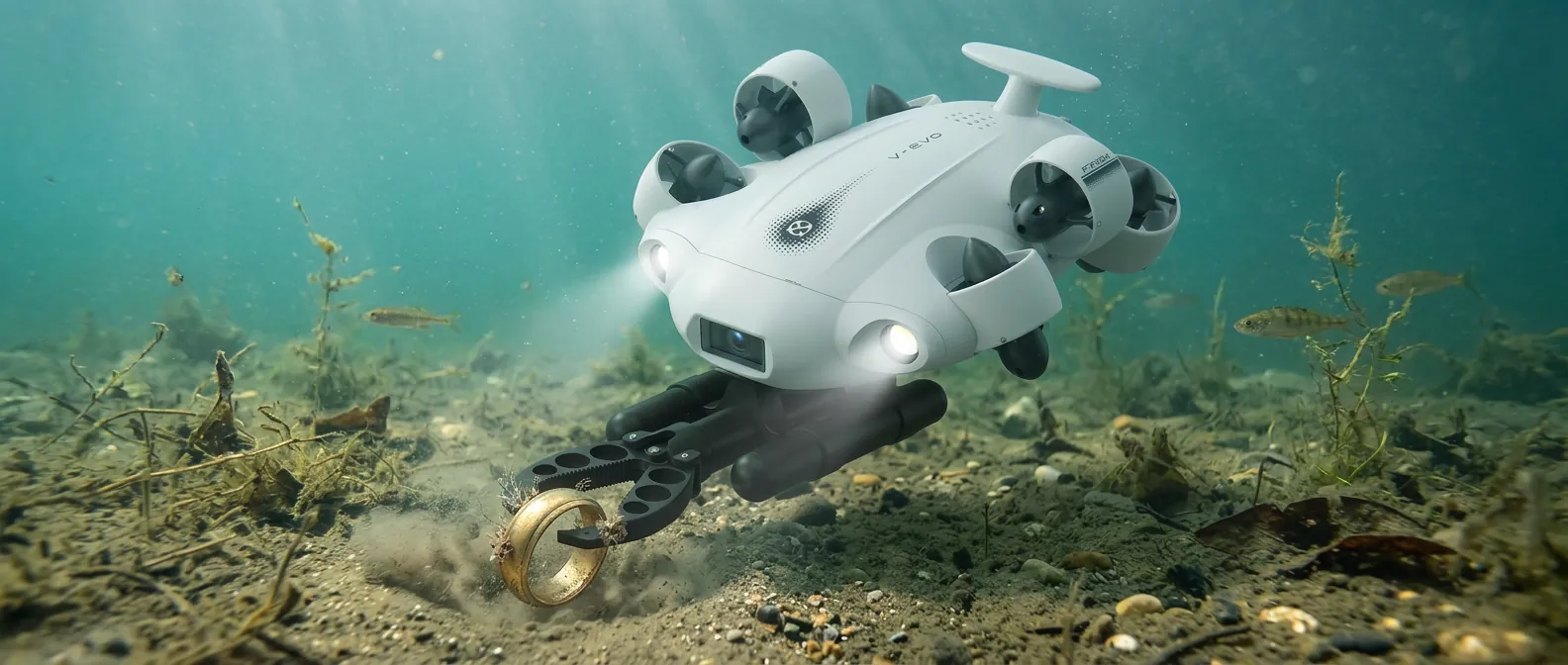
Alternatives from other manufacturers: QYSEA offers its own underwater metal detector for several FIFISH models (V-EVO, V6 Expert, E-GO). According to the manufacturer, it detects metal up to 50 cm away and through up to 50 mm of mud or sand, can dive to 100 m and costs US$399 (without guarantee, as of October 2026). We have not rated it. Larger drones such as the CHASING M2 series can additionally be fitted with a gripper arm. Which models we recommend can be found in the ranking.

Conclusion
Treasure hunting with an underwater drone is possible, but it is more delicate work than gold rush. The Dory Explore is a cheap way in with a very short detector range. The new metal detector accessory for the GO1 app is intriguing, but details are still missing. And whatever you search with: clarify beforehand whether you may search at that spot, and report what you find.
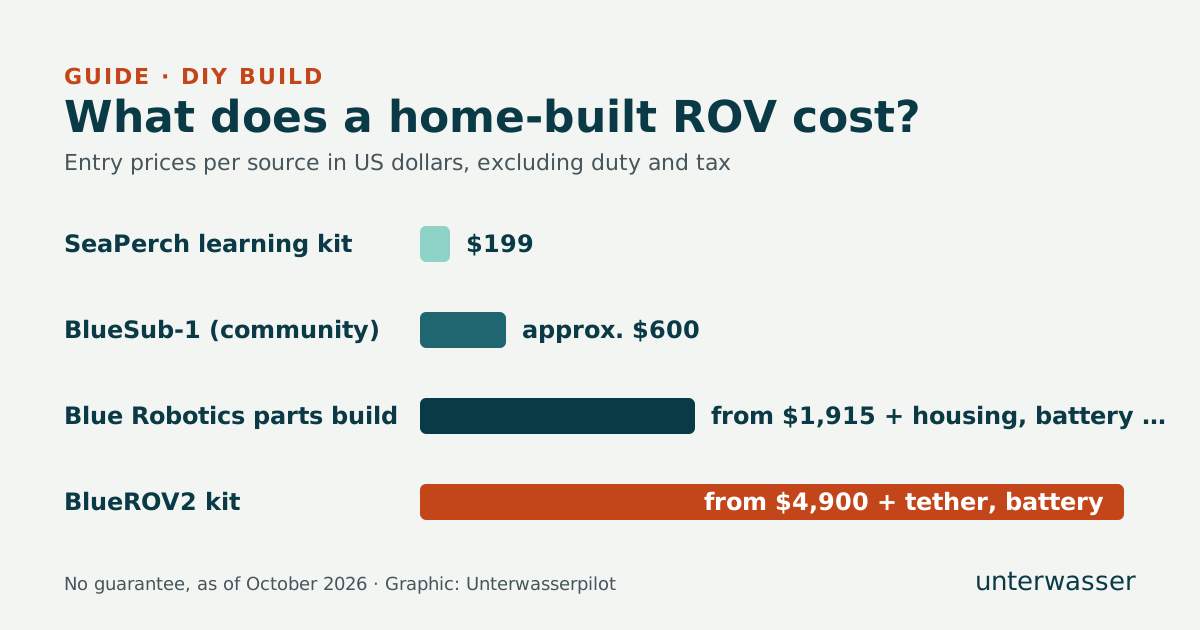
Have you already found something – or are you still searching? Tell us about it in the Unterwasserpilot forum (German). And if you would rather tinker yourself, our guide Build your own ROV has an honest overview of the costs.
Frequently asked questions
Am I allowed to search for treasure with an underwater drone?
That depends on the country and place, and this is not legal advice. In Austria, searching for archaeological monuments without a permit from the Federal Monuments Authority is prohibited, expressly also under water and with metal detectors (§ 10 Monuments Protection Act). In Germany, each federal state regulates permits itself, and in Switzerland many cantons do; in Aargau, for example, searching with technical aids requires a permit. If in doubt, ask the heritage authority beforehand.
What can the Chasing Dory Explore do?
It is a treasure-hunting version of the small Dory with a built-in metal detector and a detachable net. According to the manufacturer, it dives to 15 metres, weighs around 1.1 kilograms and films in Full HD. The launch price was US$599. According to reports, the detector only responds at about 4 to 5 centimetres.
What do I have to do if I find something?
You must report lost items in Austria (ABGB § 390), Germany (BGB § 965) and Switzerland (ZGB Art. 720), usually to the lost property office or the police. The threshold is about €10 or CHF 10. In Austria, you must report archaeological finds to the Federal Monuments Authority without delay.
Are there alternatives to the Dory Explore?
QYSEA offers its own underwater metal detector for several FIFISH models (V-EVO, V6 Expert, E-GO). According to the manufacturer, it detects metal up to 50 centimetres away and through up to 50 millimetres of mud or sand, can dive to 100 metres and costs US$399. We have not rated it.
Is treasure hunting with an underwater drone worth it?
Rather for things lost at a known spot in clear, calm and shallow water, for example a key under the jetty. It is poorly suited to systematically searching large areas, in murky water or in currents.
You can find reactions and comments on this article in the Unterwasserpilot forum (in German, English posts welcome).
- CHASING: Dory Explore – product page
- CHASING: Dory Explore – overview
- Interesting Engineering: Dory Explore (31 Dec 2024)
- Circuit Digest: Dory Explore (2 Jan 2025)
- Apple App Store: CHASING GO1
- QYSEA: Underwater Metal Detector
- RIS: ABGB § 390 (finds)
- RIS: ABGB § 391
- RIS: ABGB § 398 (treasure)
- RIS: ABGB § 399
- RIS: Monuments Protection Act § 8 (chance finds)
- RIS: Monuments Protection Act § 9
- RIS: Monuments Protection Act § 10 (investigations, metal detectors)
- Federal Monuments Authority: information sheet “Die Suche nach Bodenfunden” (searching for ground finds)
- Kuratorium Pfahlbauten: fact sheet on the UNESCO pile dwellings
- BGB § 965 (finder’s duty to report)
- BGB § 984 (treasure find)
- Bavarian Monuments Protection Act (Art. 7, 8, 9)
- Bavaria: GVBl. 2023 p. 251 (Schatzregal)
- BLfD: information for metal detectorists
- Denkmalpflege in Baden-Württemberg: monument protection act, pile dwellings and wrecks
- Fedlex: Swiss Civil Code (Art. 720–724)
- Canton of Aargau: use of metal detectors
Lost something important underwater that a hobby drone can no longer recover? UDRA offers professional recovery missions in Austria.