Sonar sounds like something from a submarine film, but it is now available even for smaller underwater drones. Before you spend any money, it is worth taking a close look: there is a world of difference between a 100-gram echo sounder and a multibeam sonar that costs as much as a small car. And by no means every hobby drone can control a sonar in the first place.
Important to know up front: we have not yet tried a sonar on a drone ourselves. Everything here is based on manufacturer specifications, retailer pages and specialist sources. It is an assessment, not a hands-on test.
- Sonar measures with sound: a pulse goes out, the echo comes back, and the distance follows from the travel time.
- It works regardless of visibility, but does not provide a colour picture.
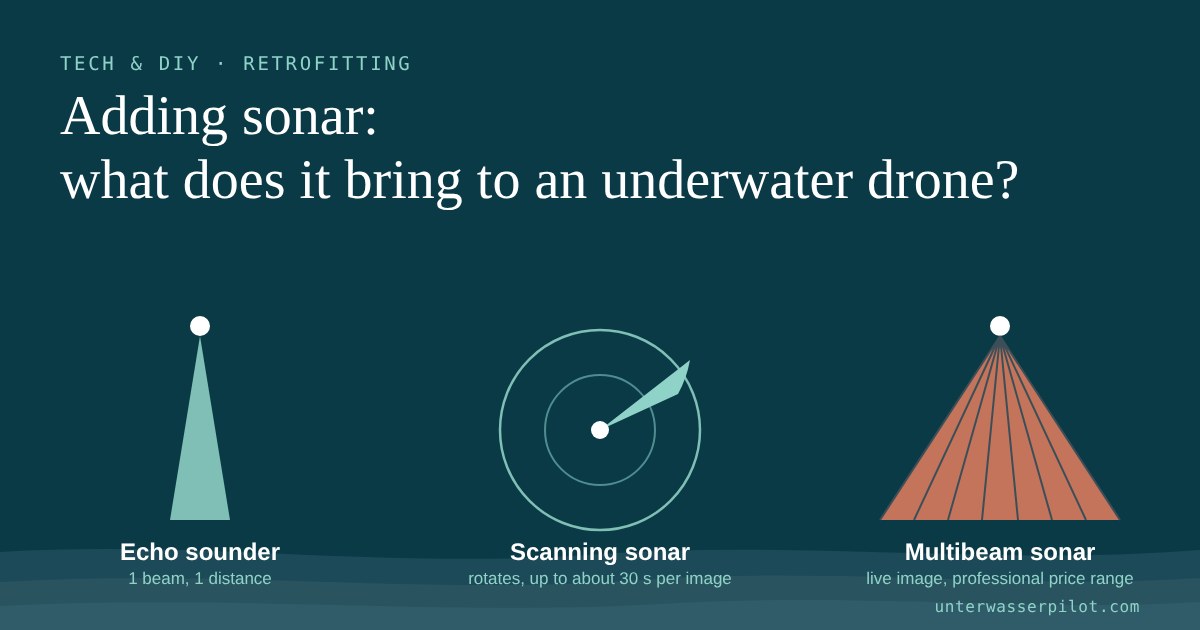
- Three classes: echo sounder/altimeter (one distance), scanning sonar (all-round picture, slow), multibeam imaging sonar (live picture, expensive).
- According to our research, official sonar accessories mainly exist for the professional lines: the Chasing M2 series and the FIFISH V6 Expert/PRO models.
- Prices range from around US$430 (echo sounder for DIY builds) to professional systems “on request”.
How sonar works
SONAR stands for “Sound Navigation and Ranging”. An active sonar sends a sound pulse into the water. If it hits an object, an echo comes back. Because the device knows the time between sending and receiving, it can calculate the distance. That is how the US ocean agency NOAA explains it.

The big advantage underwater: suspended particles that dazzle your camera with backscatter hardly bother sound. Blue Robotics describes its Ping360 in exactly this way: it is meant to provide points of orientation “regardless of the visibility in the water”.
The downside: a sonar shows shapes and edges, no colours and no fine detail. Whether there is a branch or a lost rudder down there is usually still decided by the camera in the end. For search tasks it is also worth reading our guide Treasure hunting underwater: what the metal detector on the CHASING drone can do, and what is allowed.
The three types of sonar at a glance
1. Echo sounder and altimeter (single beam)
A single sound beam measures one distance, for example to the bottom. This is the simplest and cheapest sonar.
The best-known example is the Ping2 from Blue Robotics (listed in the shop as “Ping Sonar Altimeter and Echosounder”). According to the manufacturer:
- typical range 0.3 to 100 m, beam width 25 degrees, 115 kHz
- 187 g on land, 100 g in water (each with cable)
- rated to 300 m depth, supply 4.5 to 5.5 V
- serial interface, “Ping Viewer” software for Windows, Mac and Linux
For hobby pilots this means: you can see how high you are hovering above the bottom or how far away the next wall is. You do not get a picture.
2. Scanning sonar (mechanically rotating)
Here a motor turns the transducer in a circle, step by step. This produces a round picture of the surroundings, similar to a radar screen.
The Ping360 from Blue Robotics is the classic. According to the manufacturer, the transducer rotates in 1-degree steps and builds up a picture with a range of up to 50 m. Further manufacturer specifications:
- minimum range 0.75 m, 750 kHz, beam 2 degrees horizontal and 25 degrees vertical
- a full 360-degree revolution takes roughly 3.4 to 33 seconds depending on the range
- 510 g on land, 175 g in water, rated to 300 m depth
- 11 to 25 V, maximum 5 W, connection via USB, Ethernet or RS485
The slow frame rate is the catch: at long range, an all-round picture takes more than half a minute. That makes this sonar better for getting your bearings while stationary than for driving by the sonar image.
3. Multibeam imaging sonar
A multibeam sonar sends many beams at the same time and so delivers a continuous picture, almost like a video in greyscale. This is the professional class.
One example is the Oculus M750d from Blueprint Subsea, which QYSEA also offers for FIFISH. According to the manufacturer:
- two frequencies: 750 kHz with a range of up to 120 m or 1.2 MHz with up to 40 m
- up to 512 beams, 130-degree horizontal field of view
- 980 g on land, 360 g in water
Here you can see a typical pattern: the higher frequency does not reach as far but shows finer detail (according to QYSEA 0.6 instead of 1 degree resolution).
There are also side-scan and forward-scan devices such as the Omniscan 450 from Cerulean Sonar. According to the retailer, the forward-scan model (FS) works at 450 kHz with a range of up to about 120 m and is also offered for the Chasing M2 Pro Max.
What do Chasing and QYSEA officially offer?
Chasing
Chasing promotes the M2 Pro Max with five accessory ports and more than 20 own and third-party accessories. The product page lists “BP imaging sonar”, “GEMINI imaging sonar” and “Distance lock sonar” as sonar categories. At retailers you will find, among others:

- Distance Lock Sonar: according to the retailer, it holds a fixed distance from walls or hulls and warns of obstacles. Compatibility according to the retailer: M2, M2 S, M2 Pro and M2 Pro Max (although the page contradicts itself at one point).
- Ping360 Sonar Kit: according to a US retailer only for the M2 Pro and M2 Pro Max, with mount and buoyancy body. The mount weighs roughly 705 to 763 g depending on the model.
- Oculus multibeam (e.g. M370s) and Omniscan 450 FS: on request only.
According to the App Store, the CHASING GO1 control app supports the M2 as well as the Gladius Mini and Gladius Advanced Pro. The release notes have shown new sonar accessories again and again since 2023, in 2024 for example “Side-Scan Sonar Accessories” (app and drone firmware update required).
For the Gladius Mini S and the Dory we found no official sonar accessories.
QYSEA (FIFISH)
QYSEA lists the M750d Imaging Sonar in its own shop. According to the FAQ, it fits the FIFISH V6 Expert, PRO V6 PLUS and PRO W6, and according to the manufacturer it is operated from within the FIFISH app. The shop does not state a price.
For the FIFISH V-EVO, QYSEA names accessories such as a gripper arm and metal detector on the product page, but no sonar.
Excursus: where am I? USBL and DVL
A sonar shows you what is around the drone. Where the drone itself is gets answered by positioning systems:
- USBL (Ultra-Short-Baseline): a transmitter on the drone “pings” an antenna at the surface, and the position is calculated from that. One example is the Underwater GPS G2 from Water Linked: the locator on the drone transmits, four receivers in the antenna determine direction and distance, and a pressure sensor determines depth. For the M2 Pro and M2 Pro Max, Chasing offers a Cerulean USBL, which a German retailer lists as “offer on request”.
- DVL (Doppler Velocity Log): measures speed over the ground using the Doppler effect, which makes position hold and autonomous navigation possible. The Water Linked DVL costs from US$8,710 at Blue Robotics.
For the local swimming lake, both are clearly oversized. It gets interesting for search jobs over larger areas.
What does sonar bring in a murky lake?
Our assessment for hobby pilots:

- Orientation: a scanning or multibeam sonar shows you jetties, banks, wrecks and rocks before the camera sees them. That helps you approach them deliberately.
- Searching: larger objects on smooth ground stand out in the sonar picture. Small items such as a phone tend to get lost.
- Keeping your distance: an echo sounder or distance-lock sonar helps you avoid driving into the mud. That protects visibility, because stirred-up bottom is the biggest visibility killer.
- Not a miracle cure: reading sonar images correctly takes practice. Shadows, echoes from the tether and multiple reflections can be confusing.
Weight, trim, power and software
Before you bolt on a sonar, think about four things:
- Weight and trim: every gram in the water changes the drone's attitude. With the Ping360 kit, Chasing solves this with a buoyancy body made of PVC foam. With DIY builds you have to balance it yourself.
- Power: the Ping2 needs 5 V, the Ping360 11 to 25 V. Hobby drones generally have no open power connection for third-party devices.
- Data path: the sonar picture has to get to the surface. With official kits this runs over the cable and the app. Third-party sonars need their own software (Ping Viewer, SonarView) and a connection through the tether, which closed hobby drones usually do not offer.
- Platform: open to your own accessories are mainly DIY platforms such as the BlueROV2 with ArduSub and BlueOS. More on this in Build your own ROV instead of buying: what works under €1,000, under €2,000 and with the BlueROV2?.
What does a sonar cost? The overview
| Device | Type | Fits | Price according to source | Converted approx. |
|---|---|---|---|---|
| Blue Robotics Ping2 | Echo sounder/altimeter | DIY, BlueROV2 | US$430 | €390 |
| Blue Robotics Ping360 | Scanning sonar | DIY, BlueROV2 | US$2,750 (most recently out of stock) | €2,480 |
| Chasing Distance Lock Sonar | Distance sonar | M2 series (according to retailer) | US$1,499 | €1,350 |
| Chasing Ping360 Sonar Kit | Scanning sonar | M2 Pro, M2 Pro Max | US$5,000 (US retailer, backordered) | €4,500 |
| Cerulean Omniscan 450 SS | Side-scan | BlueROV2, BlueBoat | US$6,500 | €5,850 |
| Cerulean Omniscan 450 FS (Chasing) | Forward-scan | M2 Pro Max | on request | – |
| QYSEA M750d | Multibeam | FIFISH V6 Expert, PRO V6 PLUS, PRO W6 | not stated in the shop | – |
| Chasing Oculus M370s | Multibeam | M2 Pro Max | on request | – |
| Water Linked DVL | Positioning | BlueROV2 and others | from US$8,710 | €7,840 |
All prices without guarantee, as of October 2026. Original prices in US dollars from US retailers or manufacturers. Euro values converted at roughly 1 USD ≈ €0.90, excluding customs duty, import VAT (AT 20%, DE 19%) or Swiss VAT. For Switzerland, ask the retailer for prices in Swiss francs.
What is worth it for whom?
- Do you fly a Dory, Gladius Mini S or V-EVO? Then, according to our research, there is no official sonar. You are better off investing in lighting and technique.
- Do you have a FIFISH V6 Expert or a Chasing M2? Then there are official routes. Expect professional prices and ask the retailer about compatibility and firmware.
- Are you building your own? A Ping2 is the cheapest way into the topic, a Ping360 the next step.
Practical tip to finish
Before buying, ask the retailer in writing: which drone, which firmware, which app version? Sonar accessories are often only compatible with certain model variants, and some retailer pages contradict themselves. A clear answer in black and white saves you expensive returns.
Frequently asked questions
Can I fit sonar to my hobby underwater drone?
According to our research, official sonar kits mainly exist for professional models such as the Chasing M2 series and the FIFISH V6 Expert. We found no official sonar for the Dory, Gladius Mini S or FIFISH V-EVO.
Does sonar see better than the camera in murky water?
It works with sound instead of light, so it does not depend on visibility. However, it only shows shapes and edges, no colours.
What is the difference between scanning and multibeam sonar?
A scanning sonar rotates a single transducer in a circle and needs up to about 30 seconds for an all-round picture. A multibeam sonar sends many beams at once and delivers a continuous image, but is much more expensive.
What does the cheapest sonar for an ROV cost?
According to the manufacturer, the Blue Robotics Ping2 echo sounder costs US$430 (no guarantee, as of October 2026). It only measures a single distance and does not produce an image.
In video
Blue Robotics shows its scanning sonar:
You will find reactions and comments on this article in the Unterwasserpilot forum (in German, English posts welcome). Already have a sonar on your drone? Show us your setup!
- NOAA Ocean Service, “What is sonar?” (operating principle, terminology)
- Blue Robotics, Ping Sonar Altimeter and Echosounder / Ping2 (price US$430, data)
- RobotShop, product name “BlueRobotics Ping2 Sonar Altimeter and Echosounder”
- Blue Robotics, Ping360 (price US$2,750, data, visibility quote, how it works)
- Blueye Robotics, Oculus M750d (frequencies, range, beams, weight)
- QYSEA Store, M750d Imaging Sonar (compatibility V6 Expert, PRO V6 PLUS, PRO W6; app integration; resolution)
- Chasing, M2 Pro Max feature overview (5 accessory ports, sonar categories, 20+ accessories)
- Maverick Drone, CHASING Distance Lock Sonar (function, compatibility, US$1,499)
- Scuba.com, CHASING Ping 360 Sonar Kit (compatibility M2 Pro/Pro Max, US$5,000, mount weight, buoyancy body)
- Blue Skies Drone Shop, Chasing M2 Pro Max Oculus M370s (price on request only)
- Echolotzentrum, CHASING Cerulean OmniScan 450 FS (450 kHz, up to approx. 120 m, on request)
- RobotShop, Cerulean Omniscan 450 Side Scan (US$6,500, 450 kHz)
- Apple App Store, CHASING GO1 (supported models, release notes sonar/USBL)
- QYSEA, FIFISH V-EVO (accessory list without sonar)
- Echolotzentrum, CHASING Cerulean USBL (for M2 Pro/Pro Max, offer on request)
- Focus Nordic, Chasing Cerulean USBL Sonar Mounting Kit MarkII (compatibility)
- Blueye Robotics, Water Linked Underwater GPS G2 (how the locator/antenna works)
- Blue Robotics, Water Linked DVL (from US$8,710, function)
Lost something important underwater that a hobby drone can no longer recover? UDRA offers professional recovery missions in Austria.