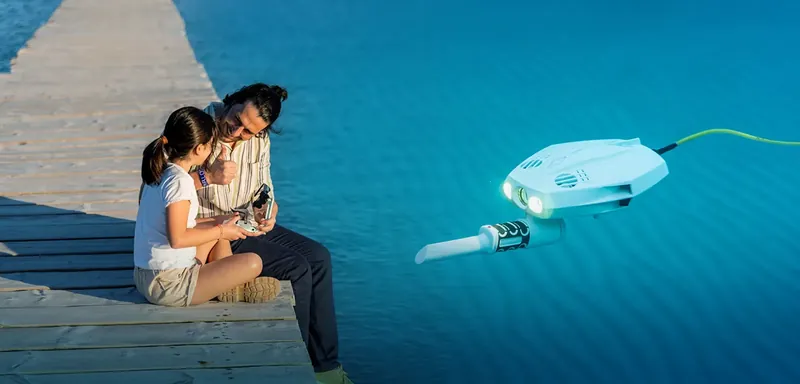
Phone, car keys, wedding ring, camera, sunglasses or a part of the outboard motor: whatever falls into the water is rarely truly lost. Often it lies on the bottom only a few metres from the jetty. With an underwater drone you have a good chance of seeing it again. Whether you can also bring it up depends on weight, ground and visibility.
Important: we have not yet done a search with a drone ourselves. The tips are based on manufacturer information, the advice of the recovery service UDRA and documented cases. This is an assessment, not a hands-on test.
- Straight away: Do not stir up the mud. Mark the spot, save the position, note reference points on the shore.
- Search: Start small and widen systematically. The more precisely the spot is known, the better the chances.
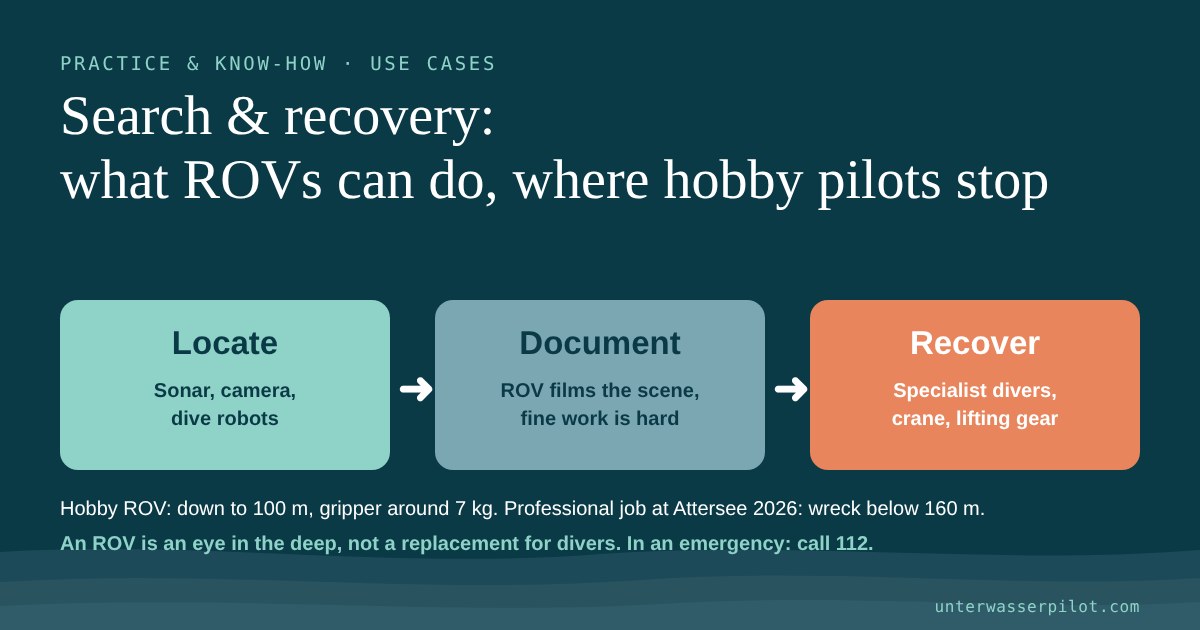
- Recovery: According to the manufacturers, gripper arms for hobby drones open 12 to 17 cm wide and grip around 7 kg. You bring up heavy things with a hook and rope.
- Law: You may get your own belongings back. Other people's finds must be reported. At bathing spots and in private waters, ask first.
Step 1: Secure the spot before you search
The first minutes decide. The Austrian recovery service UDRA recommends:

- Stay calm and do not stir up the bottom. Stirred-up mud takes away visibility and can cover the object.
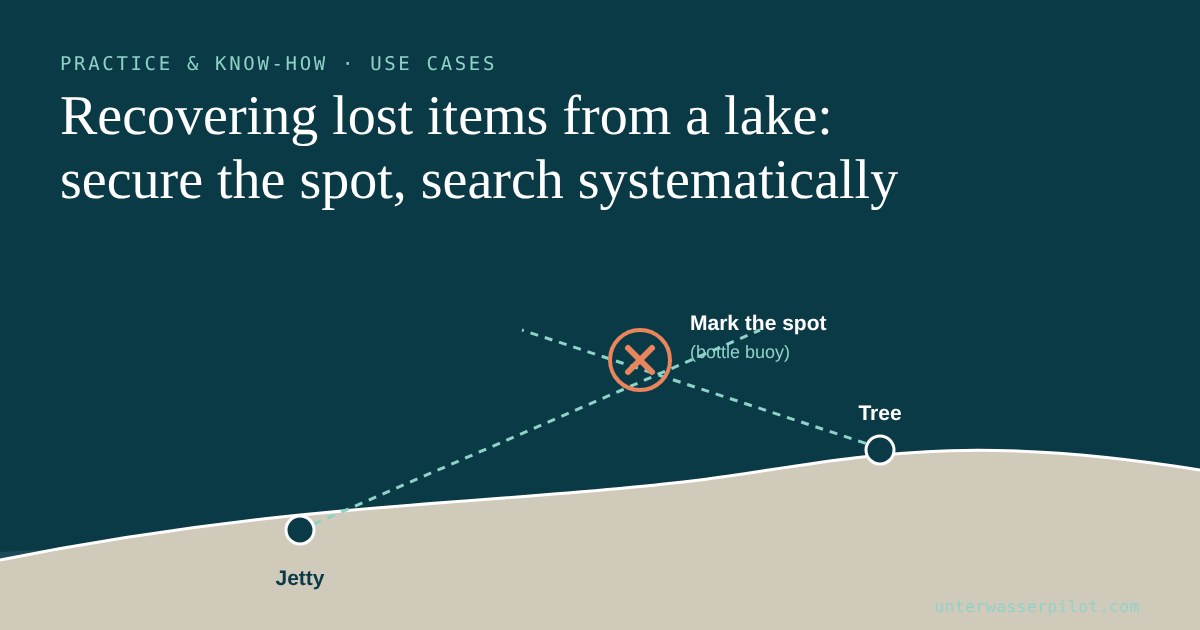
- Mark the spot, for example with a weighted bottle on a string as a makeshift buoy.
- Save the position: a photo with GPS data or a pin in the maps app.
- Note two reference points on the shore that line up with the spot, such as a jetty and a tree. Two such bearings crossing each other narrow the spot down well.
- Note the conditions: wind, waves, current, approximate depth. From these you can estimate where something may have drifted.
- Act quickly: Current and sediment move objects over time.
A phone's GPS is not accurate to the metre. Bearings on reference points are therefore a good addition.
Step 2: Search systematically
The biggest temptation: just drive off and "have a look". A plan is better.

- Start at the marker. First cover the closest surroundings before moving on.
- Lanes instead of zigzag. Drive parallel lanes or circles of growing radius around the marker. The spacing between lanes should be smaller than the width you can reliably make out on the screen.
- Slowly and just above the bottom. Keep your distance so the propellers do not stir anything up. Depth hold helps.
- Dose the light. In murky water, suspended particles reflect the light.
- Keep an eye on the cable. Jetties, buoy chains and plants are cable traps. Tips in Flying in currents: how to stay in control.
Step 3: Recovering, but with what?
Once you have found the object, the fine work begins. According to the manufacturers, these tools exist:

| Accessory | For which drones | Manufacturer data | Good for |
|---|---|---|---|
| QYSEA 2-finger gripper arm | FIFISH V-EVO, V6 Expert, E-GO | 12 cm opening, 100 N clamping force or 7 kgf (V-EVO, V6 Expert) | Phone, keys, camera, glasses |
| QYSEA Retrieval Hook | on the 2-finger arm, V-EVO, V6 Expert, E-GO | pull up to 80 kgf, rope not included | Heavy items with a rope from above |
| QYSEA metal detector | V-EVO, V6 Expert, E-GO | detects metal up to 50 cm, through up to 50 mm of mud/sand | Ring, keys in the sediment |
| Chasing Grabber Claw | Gladius Mini S | 12 cm opening, max. 7 kg | as above |
| Chasing Grabber Arm 2.0 | M2, M2 S, M2 Pro (variant for M2 Pro Max) | 17 cm opening, max. 7 kg | somewhat larger items |
| Chasing Dory Explore | own model | dip net approx. 8 cm, metal detector with a range of a few centimetres | Small items in shallow water |
All figures according to the manufacturer or retailer, without guarantee. Prices and fitting in detail: Underwater drone with a gripper arm: what you can retrofit on FIFISH and Chasing. On the Dory Explore and metal searching: Treasure hunting underwater: what the metal detector on the CHASING drone can do, and what is allowed.
And the drone itself? QYSEA gives the FIFISH V-EVO a payload of 2 kg and the V6 Expert 5 kg. For Chasing models we found no manufacturer figure.
We found no official accessory from QYSEA or Chasing for magnets on the drone. Whether a magnet can be fitted safely to the gripper arm is something you should ask the manufacturer beforehand. The drone's compass could be disturbed. That is our assumption, not a manufacturer statement.
What realistically works and what does not
| Object | Our assessment |
|---|---|
| Phone, key ring, sunglasses, small camera | Good chances if they lie visible on firm ground. Light enough for any gripper arm. |
| Ring, earring | Difficult. Small, and likes to sink into the sediment. Better chances with a metal detector or dip net, but no sure thing. |
| Part of an outboard motor, anchor | Usually too heavy for the drone alone. Only with a hook and rope from the surface, if a secure attachment point can be found. |
| Anything in soft mud | Often only with a lot of patience. Every touch clouds the water. |
| Anything deeper than the cable length or dive depth | Out of reach. According to the manufacturers, most hobby drones manage 100 m. |
How treacherous mud is shows a case from Canada reported by MPR News in 2019: an ice angler lost his phone in the lake. Underwater cameras found it, but the first recovery attempts with improvised ladles on a pipe stirred up the mud and pushed the phone deeper into the bottom. After about six hours it was finally up. No drone was used there, but the lesson applies just the same: grip slowly and from above, do not push.
Real recovery stories
- Sweden, Lake Mälaren: According to VideoRay, a team of professional divers inspecting the hull under a restaurant boat near Stockholm in 2021 spotted a phone on the bottom, about 20 feet (approx. 6 m) deep. The gripper arm of the professional ROV VideoRay Pro 4 brought it up. The phone had been lost a good five weeks earlier.
- Austria, UDRA: The recovery service UDRA works with a FIFISH V-EVO, so a drone from the hobby segment, and shows on its site the recovery of a ring with the gripper arm. But UDRA also says clearly: success is never guaranteed, and searches with little prospect are declined. Transparency: UDRA and Unterwasserpilot are run by the same operator.
What the law says
- Your own belongings: Found-property law covers things that someone else has lost. If you get your own phone back, you are not a finder within the meaning of these rules. (This is our reading of the statutory wording, not a legal opinion.)
- Other people's finds: In Austria, under § 390 ABGB you must report lost items that you take possession of to the lost-property authority and hand them in (exceptions in § 391, for example up to €10 in value). In Germany the duty to report applies under § 965 BGB, in Switzerland under Art. 720 ZGB (police report when the item is obviously worth more than CHF 10).
- Old finds: Archaeological finds and wrecks fall under heritage protection. More in Treasure hunting underwater: what the metal detector on the CHASING drone can do, and what is allowed.
- Bathing spots, harbours, private waters: Whether you may use an underwater drone there is decided by the operator or owner or the municipality. Ask beforehand and never drive while people are swimming nearby. You can find rules for individual lakes on our dive-site pages (German).
This is not legal advice.
When to call in professionals
- The object is heavy, bulky or stuck.
- The spot is deep, in a current or in a harbour with ship traffic.
- You have no drone of your own or no suitable accessory.
- It is about more than material goods, for example in an accident: then always call the emergency number 112. More in Search & recovery with an underwater drone: what ROVs can do and where hobby pilots should stop.
Frequently asked questions
Can I get my phone out of the lake with an underwater drone?
Often yes, if you know the spot well, the visibility is right and the phone lies on firm ground. You need a drone with a gripper arm. According to the manufacturers, the common arms open 12 to 17 cm wide.
Which underwater drone with a gripper arm suits private users?
For the FIFISH V-EVO and V6 Expert there is the 2-finger arm from QYSEA, for the Chasing Gladius Mini S the Grabber Claw. Our ranking shows which drone suits you.
How heavy can the object be?
According to QYSEA, the V-EVO carries 2 kg and the V6 Expert 5 kg. According to the manufacturers, the gripper arms hold around 7 kg. For heavier things QYSEA has a retrieval hook, which you use to pull from above by rope.
What do I do if I find something that is not mine while searching?
Depending on the country, inform the owner, the lost-property authority or the police. For old finds, heritage protection applies.
How do I find the spot again?
Mark it straight away, save the GPS position and note two reference points on the shore that line up. And do not stir up the mud.
In the video
A documented case from Canada (without a drone):
Practise gripping before you need it: in shallow, clear water, lay out an old bunch of keys and fetch it back with the drone. That way you learn how close you need to get and how much sediment your propellers stir up.
You can find reactions and comments on this article in the Unterwasserpilot forum (in German, English posts welcome). Have you recovered something yourself? Tell us there!
- UDRA, tips for loss in water, equipment FIFISH V-EVO, no success guaranteed
- Unterwasserpilot, UDRA profile (ring recovery with gripper arm, transparency note)
- QYSEA Store, 2-Finger Robotic Arm (100 N, 7 kgf, 12 cm, compatible models, price)
- QYSEA Store, Retrieval Hook (80 kgf, rope not included, how it works)
- QYSEA Store, Metalldetektor (50 cm, 50 mm sediment, compatible models; from our guide “Treasure hunting underwater”, checked there on 9 October 2026)
- QYSEA Store, FIFISH V-EVO (payload 2 kg)
- QYSEA Store, FIFISH V6 Expert (payload 5 kg)
- Chasing, user manual Grabber Claw A (7 kg, 120 mm; hosted by xcopter)
- Maverick Drone, CHASING Grabber Claw B (Gladius Mini S, 120 mm)
- Maverick Drone, CHASING Grabber Arm 2.0 (7 kg, 170 mm, compatible models)
- Dory Explore (dip net approx. 8 cm, detector 4–5 cm): from our guide “Treasure hunting underwater”, sources there: interestingengineering.com · circuitdigest.com
- MPR News, How to recover your cellphone from the bottom of the lake (17 January 2019)
- VideoRay, Pro 4 plucks lost cell phone from Swedish lake (December 2021)
- Found-property law AT/DE/CH from our guide “Treasure hunting underwater” (checked against the official wording on 9 October 2026): ris.bka.gv.at · gesetze-im-internet.de · fedlex.admin.ch
Lost something important underwater that a hobby drone can no longer recover? UDRA offers professional recovery missions in Austria.