An underwater drone sees places that divers can only reach with great effort, or not at all. That is exactly what makes ROVs interesting for rescue organisations. At the same time, real operations show that even professional diving robots cannot do everything. For hobby pilots that applies even more.
One thing up front: we have not accompanied a search or recovery operation ourselves. Everything here is based on reports from the organisations, press articles and manufacturer information. This is an assessment, not a hands-on test.
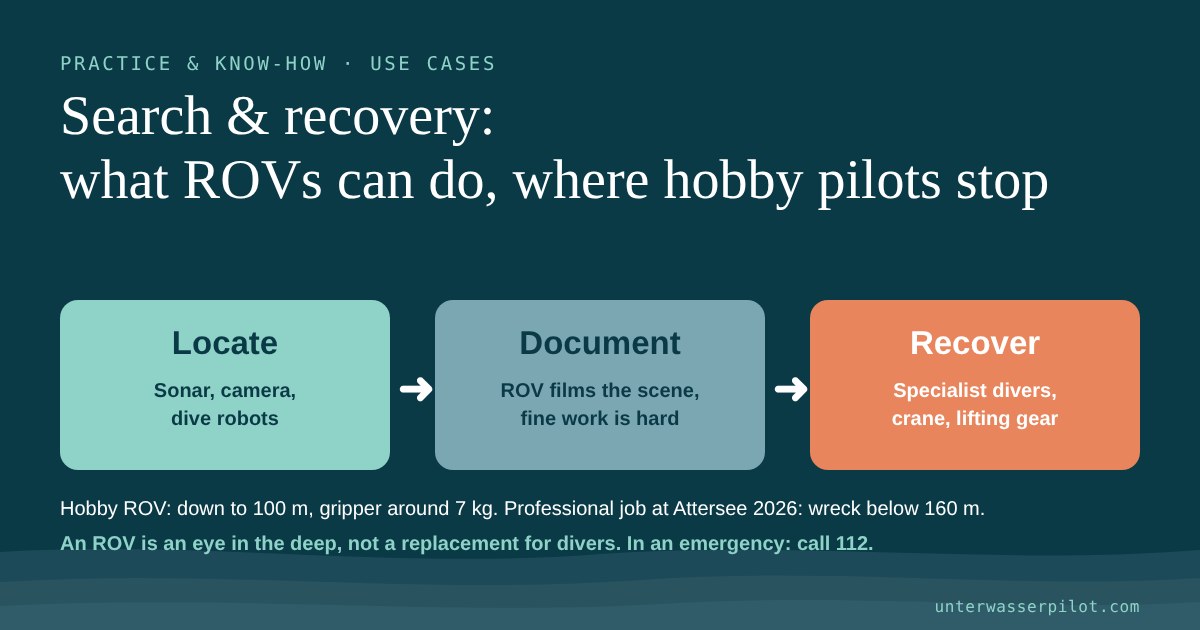
- Rescue organisations in Austria, Germany and Switzerland use diving robots mainly to locate and document, not as a replacement for divers.
- In the plane crash in Lake Attersee in August 2026, a diving robot found the wreck at a depth of around 160 metres. In the end, specialist divers recovered it.
- According to the manufacturers, hobby drones such as the FIFISH V-EVO or Chasing Gladius Mini S dive to 100 metres. According to the manufacturers, their gripper arms have around 7 kg of gripping force, and the payload is in the low single-digit kilogram range.
- For accidents and missing-person searches the rule is: call the emergency number and let the emergency services work. Do not intervene with your drone unless the incident command expressly asks you to.
How rescue organisations use diving robots
Austria: water rescue with its own robot
The ÖWR Döbriach (Austrian Water Rescue) in Carinthia uses an underwater robot that, according to rescue diver Volkmar Ertl, can work down to 200 metres. According to a MeinBezirk report from August 2026, the device has a 360-degree sonar, cameras and powerful lighting, and is meant to work even in poor visibility, in darkness or under ice. The biggest advantage according to Ertl: the robot has "practically no time limit" and needs no decompression stops. According to the same report, however, complex recoveries and heavy loads remain a job for trained divers.

Germany: DLRG, Wasserwacht, Wasserwehr
- In a flyer, the DLRG locating group Ostallgäu/Kaufbeuren lists a diving robot with a dive depth of up to 200 metres, all-round sonar, four LED lights and a gripper that opens 82 millimetres wide. According to the flyer, the group is alerted via 112 or the police.
- According to its own information, the Wasserwacht Schrobenhausen is planning a Chasing M2 Pro Max with sonar. Cost including accessories and training: around €14,000 to €18,000. Its sentence on this sums it up: the drone "complements the work of our divers but does not replace it".
- During a missing-person search in the Königssee in Plötzky (Saxony-Anhalt) in June 2026, the fire brigade, several water rescue units, divers, a water search dog and an underwater drone were deployed, according to the Volksstimme.
Switzerland: police with deep-sea technology
- According to Netzwoche, the Zurich cantonal police acquired a search robot called "Fusion" from Strategic Robotic Systems in 2022, for the "search and recovery of people and objects in bodies of water" down to about 300 metres.
- According to Baird Maritime, the Geneva navigation police received an ROV from the French manufacturer ECA Group in 2021 for search and rescue on Lake Geneva, rated to 1,000 metres.
What all the examples have in common: the robot is a tool in a team with sonar, divers and incident command. These are professional devices in a completely different price and depth class from the drones in our ranking.
The Attersee example: locating yes, recovering no
On 26 August 2026 a Tecnam P2002JF training aircraft crashed into Lake Attersee. According to Salzburg24, the wreck was found the same evening using sonar, underwater cameras and a diving robot, supported by a specialist unit of the Wasserrettung Salzburg. The robot's camera showed the wreck and the two occupants who died in the accident.
After that, it got difficult:
- According to Tips, the diving robot was first supposed to attach a recovery line to the damaged aircraft. These attempts failed.
- On 29 August the recovery was called off, according to Salzburg24. The recovery lines could not be secured on the lake bed, and, according to dive operations leader Thomas Manahl, wind and rain were too strong as well.
- On 31 August, according to Tips, two specialist divers finally descended to over 160 metres, made the connection, and the wreck was brought to the surface with a lifting device.
For us the most important lesson: an ROV is an excellent eye in the deep. But fine work such as securely attaching a load to a damaged object is hard even for professional teams with specialist equipment. We tell the whole story in our article on the Attersee recovery (planned).
Limits of hobby underwater drones
Hobby drones can do a surprising amount. For real recoveries, though, they lack reserves in several places. Here are the manufacturer figures at a glance:

| Model | Dive depth | Payload | Gripper arm (optional) | Light |
|---|---|---|---|---|
| FIFISH V-EVO | 100 m | 2 kg | 2-finger arm, 70 N or 7 kgf gripping force, 12 cm opening | 5,000 lm |
| FIFISH V6 Expert | 100 m | 5 kg | 2-finger arm, 100 N clamping force, 12 cm opening | 6,000 lm total |
| Chasing Gladius Mini S | 100 m | not stated | Grabber Claw, max. 7 kg, 12 cm opening | 2 × 1,200 lm |
| Chasing M2 series | 100 m | not stated | Grabber Arm 2.0, max. 7 kg, 17 cm opening | 2 × 2,000 lm (M2) |
All figures according to the manufacturer or retailer, sources below. More on the accessories: Underwater drone with a gripper arm: what you can retrofit on FIFISH and Chasing and More light for your underwater drone: which add-on lamps exist for FIFISH and Chasing.
What that means in practice:
- Weight: A few kilos of payload are enough for a phone, keys or a camera. Anything heavier needs a rope from the surface. For this QYSEA offers a retrieval hook that the gripper arm hooks onto the object. It is then pulled up by hand.
- Gripping: An opening of 12 to 17 centimetres is enough for many everyday objects, but not for bulky items.
- Visibility: Every contact with the bottom stirs up mud. At the Attersee the incident command spoke of very difficult conditions.
- Depth and cable: 100 metres of dive depth sounds like a lot. But the Attersee wreck lay over 160 metres deep, outside the reach of any hobby drone.
- Current and weather: Wind and rain delayed even the professional operation at the Attersee. More on this in Flying in currents: how to stay in control.
What you may and may not do as a hobby pilot
In accidents and missing-person searches
There is one clear rule here: call the emergency number and leave the field to the emergency services. In Austria, according to oesterreich.gv.at, you reach the fire brigade on 122, the police on 133, the ambulance service on 144 and the European emergency number on 112. 112 works in all EU countries.

Why you should not just head out with your drone yourself:
- A cable in the water can interfere with divers, boats and sonar.
- The incident command needs to know what is moving in the search area.
- Pictures of accident victims do not belong on the internet.
- In Germany, under § 323c (2) StGB (Criminal Code), anyone who obstructs a person who is giving or wants to give help at the scene of an accident commits a criminal offence.
What you can do instead: report your observations precisely (place, time, what you saw) and offer your drone if the incident command asks for it. Whether it accepts your offer is its decision.
If you find something
If you come across something that does not belong to you on a dive, the law on found property applies. In short:
- Austria: Anyone who takes possession of a lost item must, under § 390 ABGB, report it to the lost-property authority and hand it in. § 391 lists exceptions, for example when it is returned to the loser or when the value is up to €10.
- Germany: Under § 965 BGB you must report the find to the loser, the owner or the competent authority.
- Switzerland: Under Art. 720 ZGB you notify the owner or report the find to the police. This is mandatory if the item is obviously worth more than CHF 10.
For old finds, wrecks or in pile-dwelling zones, the heritage protection laws apply as well. Everything important on this is in our guide Treasure hunting underwater: what the metal detector on the CHASING drone can do, and what is allowed. This is not legal advice. If in doubt, ask the authority.
If you find something that looks like it is linked to an accident or a crime, such as a sunken vehicle or weapons: do not touch it, note the position and call the police.
Hobby or professional? Where to draw the line
| Task | Hobby drone | Call the professionals |
|---|---|---|
| Your own phone or keys at the jetty | often doable | if the spot is unclear or deep |
| Checking a boat, jetty or anchor | well doable | for expert reports with documentation |
| Heavy items (engine, bicycle) | only with rope and hook, if at all | usually yes |
| Missing person | no | always: emergency number 112 |
| Accident, wreck, traces of a crime | no | always: police |
The "Hobby drone" column is our assessment based on the manufacturer information, not a test result.
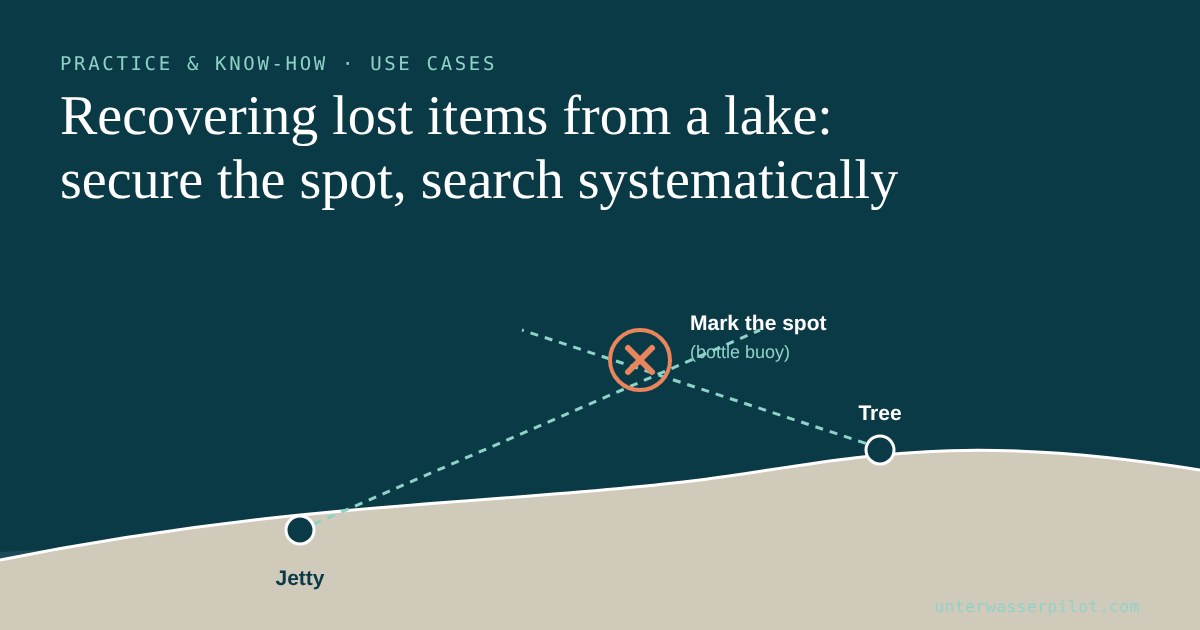
How to go about it as a private person when something has fallen into the water is what we show in Recovering lost items from a lake: how to get back a phone, keys or a ring with an underwater drone.
Frequently asked questions
May I help with a missing-person search with my underwater drone?
Only if the incident command expressly asks you to. Call the emergency number, report your observations and offer your drone. Heading out on your own can disrupt the operation.
How much can a hobby underwater drone lift?
According to QYSEA, the FIFISH V-EVO carries 2 kg and the V6 Expert 5 kg. For Chasing models the manufacturer gives no payload. According to the manufacturer, the gripper arms have around 7 kg of gripping force. You only bring heavier things up with a rope and hook.
Why did the robot not recover the plane at the Attersee?
According to press reports, the recovery lines could not be attached securely to the damaged wreck with the robot. Wind and rain came on top of that. In the end, two specialist divers made the connection at over 160 metres depth.
What should I do if I find something that is not mine underwater?
Depending on the country, inform the owner or the lost-property authority or police. For old or archaeological finds, heritage protection applies. Details in our guide Treasure hunting underwater: what the metal detector on the CHASING drone can do, and what is allowed.
Does an underwater drone replace divers?
No. Even rescue organisations describe it as a complement. It locates and documents; heavy and delicate recoveries remain a job for trained divers.
In the video
An example of a search with an underwater drone:
Save the emergency numbers of the country you dive in on your phone before the trip. And briefly note the place and time of every dive. If you ever see something unusual, you can then give the emergency services precise details.
You can find reactions and comments on this article in the Unterwasserpilot forum (in German, English posts welcome).
- MeinBezirk, “200 Meter Tiefe sind kein Problem” (ÖWR Döbriach, diving robot to 200 m, sonar, quotes from Ertl, divers for heavy recoveries; 6 August 2026)
- DLRG Kaufbeuren, locating group flyer (diving robot 200 m, sonar, 4 LEDs, gripper 82 mm, alerting via 112/police; date not stated)
- Wasserwacht Schrobenhausen, information on underwater drone/sonar (Chasing M2 Pro Max planned, €14,000–18,000, quote “ergänzt … ersetzt sie aber nicht”; date not stated, upload path 12/2025)
- Volksstimme, Wasserwehr sucht im Königssee Plötzky mit Unterwasserdrohne (June 2026)
- Netzwoche, “Kapo Zürich holt Roboter ins Boot” (Fusion, Strategic Robotic Systems, approx. 300 m; 7 October 2022)
- Baird Maritime, Geneva Navigation Police gets SAR-optimised ROV (ECA Group, 1,000 m; 1 June 2021)
- Salzburg24, crash into the Attersee (26 August 2026, located with sonar, cameras, diving robot, Wasserrettung Salzburg)
- Salzburg24, recovery called off (29 August 2026, recovery lines not secured, wind/rain, quote from Manahl)
- Tips, Verunglücktes Kleinflugzeug aus Attersee geborgen (31 August 2026, robot operation failed, two specialist divers, 163 m)
- QYSEA Store, FIFISH V-EVO (payload 2 kg, 5,000 lm)
- QYSEA, FIFISH V-EVO product page (gripper arm 70 N)
- QYSEA Store, FIFISH V6 Expert (payload 5 kg)
- QYSEA Store, 2-Finger Robotic Arm (100 N, 7 kgf, 12 cm, compatible models)
- QYSEA Store, Retrieval Hook (recovery hook, rope required)
- Chasing, user manual Grabber Claw A (max. 7 kg, 120 mm, Gladius series; hosted by xcopter)
- Maverick Drone, CHASING Grabber Arm 2.0 (7 kg, 170 mm, M2/M2 S/M2 PRO)
- Chasing, Gladius Mini S Specs (2 × 1,200 lm, 100 m)
- Chasing, M2 Specs (2 × 2,000 lm, 100 m)
- oesterreich.gv.at, Notrufnummern (122, 133, 144, 112)
- gesetze-im-internet.de, § 323c StGB
- Found-property law AT/DE/CH: taken over from our guide “Treasure hunting underwater” (checked there against the official wording on 9 October 2026): ris.bka.gv.at · gesetze-im-internet.de · fedlex.admin.ch
- UDRA, services and equipment
Lost something important underwater that a hobby drone can no longer recover? UDRA offers professional recovery missions in Austria.